
Loving the alien
Bowie, Ziggy, and telling your own story .
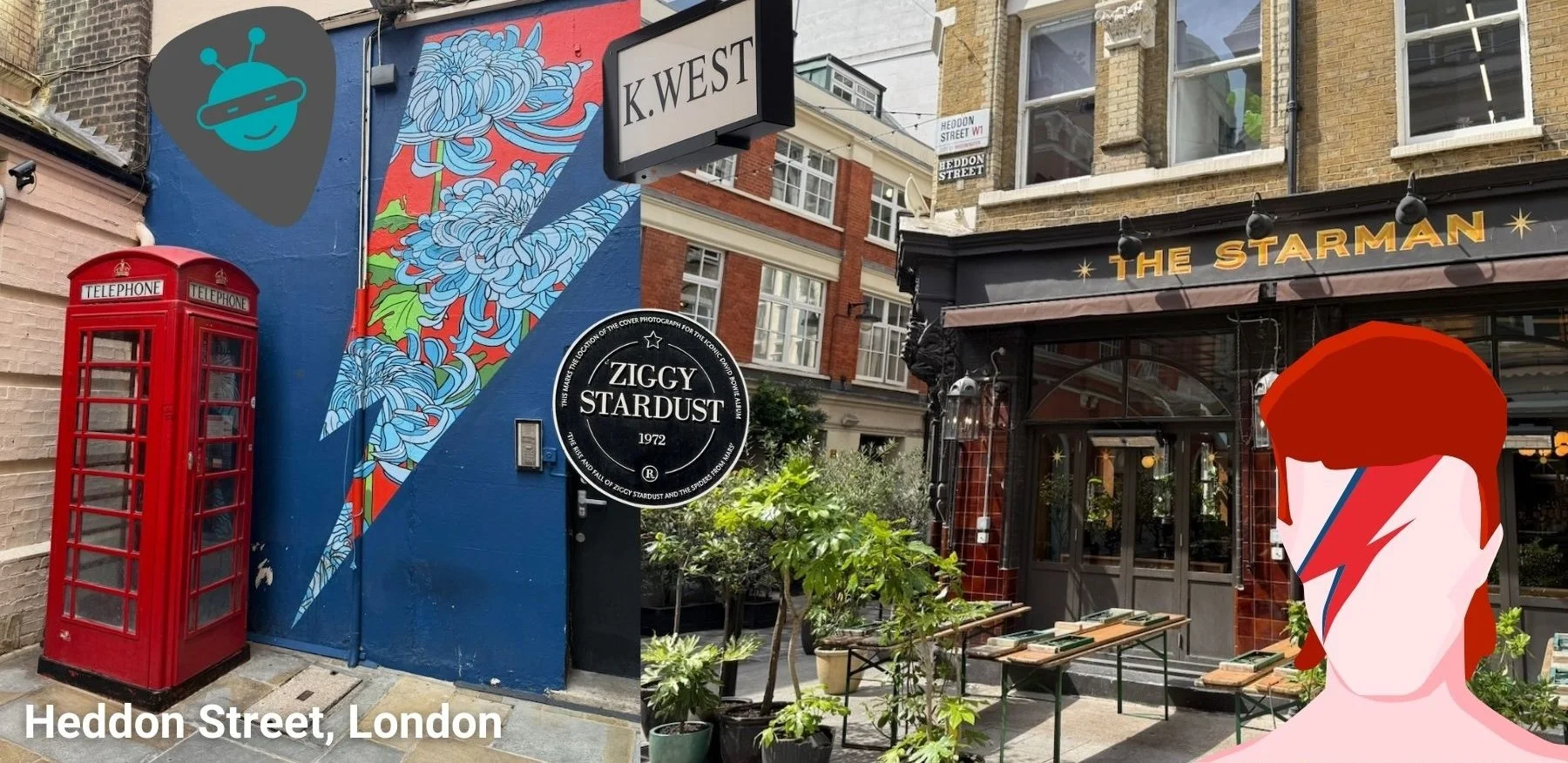
Photos taken by Mark Dauner on London’s Heddon Street, photo location of the Rise and Fall of Ziggy Stardust and the Spiders from Mars album cover.
“You're too old to lose it, too young to choose it. And the clocks waits so patiently on your song.”
— David Bowie, “Rock n’ Roll Suicide”, 1972
We’ve now lived for 10 years in a world without David Bowie. And yet, it seems that in the decade since Bowie’s passing, we’ve lived in a world that is more full of Bowie than ever. His music has been discovered by new audiences – and rediscovered by older ones. Upon visits to Bowie’s hometown of London you can’t miss the subtle, and not-so-subtle tributes to David Bowie across the city.
Bowie was different. He was unique. David Bowie was a one-of-a-kind artist that can be borrowed from, but never totally replicated. He was alien, and yet he was the most human.
David Bowie is gone – and yet he lives on. Part of that cultural resonance has to do with, of course, the catchy music, the unmistakable voice, and the oft-changing image. But I would contend that all of those things are individual parts of a bigger picture about David Bowie: his ability to tell a compelling story that connected with people.
Spiders from Mars
Simplicity creates space
David Bowie understood something fundamental about storytelling that most creators spend years trying to figure out: simplicity. His mystique, his characters, and his somewhat distant persona made his art feel complex and elaborate. Sometimes it was at the presentation layer. But at his core, Bowie knew the secret to telling a great story: let your audience do some of the work.
In 1972, Bowie released The Rise and Fall of Ziggy Stardust and the Spiders From Mars, a concept album about an androgynous alien rock star who comes to Earth, achieves epic fame, buys into his own hype, and self-destructs on stage. It's one of the most influential rock albums ever made.
Here's part of what made it brilliant (and my favorite album): simplicity.
"I wanted to define the archetype. Messiah rockstar. That's all I wanted to do,” told Bowie in a 1977 interview. “And I used the trappings of Kabuki theater, mime technique, and fringe New York music. So Ziggy was, for me, a very simplistic thing. It was what it seemed to be: an alien rockstar."
That simplicity created space. Fans brought their own meaning to Ziggy. They saw themselves in him. They projected their fears and dreams onto this character Bowie had sketched in broad strokes.
"Other people re-read him and contributed more information about Ziggy than I had put into him," added Bowie.
Ashes to Ashes
Borrowing from the familiar
Bowie didn't create Ziggy from scratch. He borrowed from existing culture. None of these elements were entirely original. The magic happened in how he combined them.
"It was a theater piece," Bowie explained. "The Spiders didn't really exist. They only existed for the length of duration of that character's life."
He also built the album using multiple points of view. The character himself. Two other observers. "It was the way an author would write a book," he said. "It hadn't been utilized that much in records."
But underneath all these techniques, the core concept remained absurdly simple: Alien. Guitar. Stardom. Death.
Sound and Vision
Less explanation helps with connection
Simplicity isn't about dumbing things down. It's about creating a clear framework that lets complexity emerge naturally. When you start with a simple concept, you give your audience room to interpret, to fill gaps, to make the story their own.
Vanessa Boris and Lani Peterson explain it this way in a 2018 brief from Harvard Business Publishing: "Storytelling works because it parallels the ways in which we receive, analyze, organize, and archive any information that comes into our brains. Facts enter as data points; stories connect the dots."
Stories don't just deliver information. They create neural pathways. They change how we think. But only if there's enough space in the narrative for our brains to do that connecting work.
Quicksand
Keep AI out of your gaps
In the time since David Bowie left the planet, we have a powerful new tool for creativity at our disposal: generative AI. I am a proponent of AI for everything from automation and efficiency, to a tool for creativity.
But there’s a problem with generative AI that makes it really tough to tell an effective story. It's designed to fill in those empty spaces. That's literally what it does. It predicts the next word, the next sentence, the next logical beat in a narrative. When you ask AI to help tell your story, it completes patterns. It explains connections. It fills gaps.
Over-rely on it, and you end up with content that leaves nothing to the imagination. Every beat is hit. Every connection is made explicit. Every gap is filled. The audience becomes passive rather than active. They consume rather than interpret.
Bowie's genius was knowing what to leave out. He gave you just enough to spark your imagination, then stepped back and let you do the rest. AI's instinct is the opposite. It wants to give you everything, explain everything, connect every dot.
So here’s a tip for creativity with generative AI (or simply with your own writing) that I don’t often see people talk about: be ruthless. Don’t over-explain. Remove the redundant beats. Create breathing room. Trust your audience, the way Bowie trusted his audience to have the intelligence to take their own leaps.
Diamond Dogs
Is AI dragging you down to the mean?
Research from 2024 by Anil Doshi and Oliver Hauser found that writers using AI-generated story ideas produced work that readers rated as more creative, better written, and more enjoyable, especially if the writers were less experienced. In visual arts, a study by Elm Zhou and Donghao Lee showed that using text-to-image AI increased artists' output by about 25% and boosted audience engagement by 50%.
That same study by Doshi and Hauser showing improved creative quality found that AI-assisted stories were significantly more similar to each other than human-only stories. When everyone uses the same AI tools, everything ends up sounding alike.
The researchers called it a social dilemma. Individually, you might produce better work with AI help. Collectively, we're creating a narrower, more homogenized pool of stories.
Other research confirms this. Zhou and Lee's analysis of artists using generative image models showed productivity increased but average novelty declined over time. AI remixes what already exists. Without careful human guidance, you get competent but predictable output.
Kim Fox, a professor at the American University in Cairo, experimenting with AI-written audio drama scripts in creative education, found the results "grammatically sound but leaning on stereotypes and hokey tropes.”
This is why people have taken to calling obvious AI-generated content "AI slop."
If Bowie had used an AI tool to create Ziggy Stardust based on existing rock star narratives, would we have gotten something as weird and memorable? Or would we have gotten a statistically average rock opera that checked every box but broke no new ground?
AI works from averages. Bowie worked from intuition — from odd juxtapositions — from a vision that didn't yet exist in data.
Hang on to Yourself
The humanity factor
People know when something feels machine-generated. Also, they care.
A 2023 study by Louis Bellaiche and colleagues found that people consistently preferred art they believed was human-made over art labeled as AI-generated, even when the works were identical. Participants saw more "story," "effort," and "meaning" in the human-labeled pieces.
We value the human behind the work. We want to know there's a real person with real experiences shaping what we're consuming.
Authenticity isn't the same as fluency. AI can string words together beautifully. That doesn't mean those words carry weight.
Real authenticity comes from three things AI can't fake:
Personal voice and tone: The way you naturally express ideas, the rhythm of your sentences, the words you choose.
Unique perspective: How you see the world based on where you've been and what you've lived through.
Consistent style and intent: A through-line that runs through your work because it comes from you, not from a prompt.
Fully AI-generated content might be error-free and well-structured, but it lacks spark. It doesn't connect.
Station to Station
Consistency beneath the surface
Bowie constantly shifted personas, from Ziggy, to the Thin White Duke, to his later experimental work. But underneath every character, you could hear Bowie. His curiosity. His intelligence. His willingness to take risks. That consistency of spirit, even as the surface changed, created trust with his audience.
"It was still very hard for anybody to realize that a rock artist can go on stage and be a different person every time," Bowie said. "You don't have to be the same personality every time you go on stage, and mine was more exaggerated."
He was playing characters, but the person choosing those characters, crafting those performances, was always authentically Bowie.
Reality
Own your message
It’s ok to use AI. I use it every day. Sometimes I work with the robots more than with the people. I would never presume to speak for David Bowie, but based on his willingness to experiment and embrace new technologies and new ideas in his art, I have a feeling he would be experimenting with generative AI. You could be sure that it would be in a way that supported his story, his message, and his point-of-view.
I think that, when incorporating AI into creative projects we need to maintain that same level of ownership. We’re the directors of our message. The AI is at least, a tool, and at most, a supporting collaborator - like Brian Eno.
Am I saying that AI is the Brian Eno of the modern era? Somebody has to, and I’ll say more on that in a future post.
Blackstar
Stay true to your story
On January 8, 2016, on his 69th birthday, and just two days before his death, David Bowie released Blackstar. The album, which is full of inspirational nods to experimental jazz, hip hop, and modern art, deals with the concepts of death and dying. It’s a poignant record that is ethereal sounding and moody. I love it, but I can only listen to it at the right moments.
David Bowie, even up to his death, was obsessed with telling his story the way he wanted to tell it, with his own personal inspirations, and on his own terms.
Simple concepts. Constant experimentation. Always, always staying in control of the sound and vision. That’s the lesson that I take from David Bowie. Lean on your influences. Embrace tools and technology as a means to tell your story. Don’t be afraid to experiment. Most importantly, never forget that our story is ours to tell. Don’t outsource that part to a machine.
I'm a blackstar, way up, on money, I've got game.
I see right, so wide, so open-hearted pain.
I want eagles in my daydreams, diamonds in my eyes.
— David Bowie, “Blackstar”, 2016